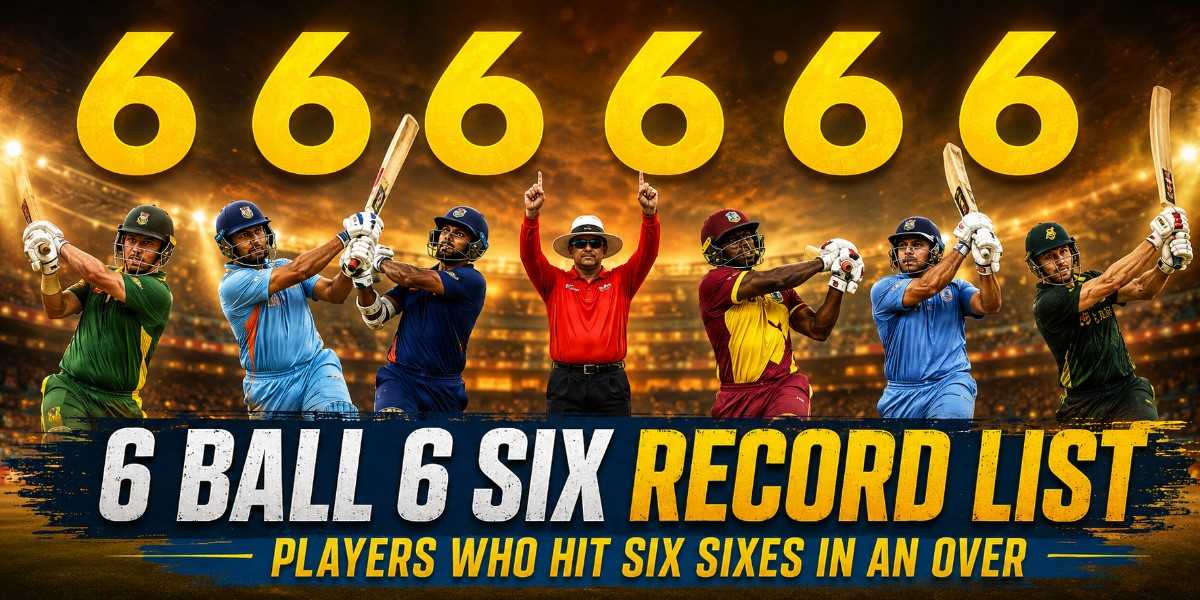
Six balls can turn a normal over into cricket history. A batter needs power, timing, courage, and a bowler under sudden pressure. One mistimed swing ends the attempt. One wide yorker breaks the rhythm. One fielder on the rope can change the story.
The 6 Ball 6 Six Record List began with Sir Garry Sobers in 1968 and has grown across first-class cricket, ODIs, T20Is, and franchise tournaments. The feat is still rare because it asks for six perfect attacking shots in one over, with no pause in belief.
This list covers the major professional and international entries that cricket fans search for most, including Yuvraj Singh six sixes, Herschelle Gibbs six sixes, Jaskaran Malhotra, Kieron Pollard, Dipendra Singh Airee, Darius Visser, and Kushal Bhurtel.
6 Ball 6 Six Record List for Quick Reading
| No | Player | Team | Opponent | Format | Year | Bowler |
| 1 | Sir Garry Sobers | Nottinghamshire | Glamorgan | First-class | 1968 | Malcolm Nash |
| 2 | Ravi Shastri | Bombay | Baroda | First-class | 1985 | Tilak Raj |
| 3 | Herschelle Gibbs | South Africa | Netherlands | ODI | 2007 | Daan van Bunge |
| 4 | Yuvraj Singh | India | England | T20I | 2007 | Stuart Broad |
| 5 | Ross Whiteley | Worcestershire | Yorkshire | T20 | 2017 | Karl Carver |
| 6 | Hazratullah Zazai | Kabul Zwanan | Balkh Legends | T20 | 2018 | Abdullah Mazari |
| 7 | Leo Carter | Canterbury Kings | Northern Knights | T20 | 2020 | Anton Devcich |
| 8 | Kieron Pollard | West Indies | Sri Lanka | T20I | 2021 | Akila Dananjaya |
| 9 | Thisara Perera | Sri Lanka Army | Bloomfield | List A | 2021 | Dilhan Cooray |
| 10 | Jaskaran Malhotra | United States | Papua New Guinea | ODI | 2021 | Gaudi Toka |
| 11 | Ruturaj Gaikwad | Maharashtra | Uttar Pradesh | List A | 2022 | Shiva Singh |
| 12 | Dipendra Singh Airee | Nepal | Qatar | T20I | 2024 | Kamran Khan |
| 13 | Darius Visser | Samoa | Vanuatu | T20I | 2024 | Nalin Nipiko |
| 14 | Manan Bashir | Bulgaria | Gibraltar | T20I | 2025 | Louis Bruce |
| 15 | Aakash Choudhary | Meghalaya | Arunachal Pradesh | First-class | 2022 | Lima Dabi |
| 16 | Kushal Bhurtel | Nepal | China | T20I | 2023 | Chen Zhuo |
The First Set of 6 Ball 6 Sixes Came From Sir Garry Sobers
Sir Garry Sobers gave cricket its first famous entry in this club. He was playing for Nottinghamshire against Glamorgan in Swansea in 1968. Malcolm Nash was the bowler, and Sobers cleared the boundary six times in the over.
The fifth hit carried extra drama. A fielder near the rope caught the ball but crossed the boundary, which made it six. The final ball then disappeared over the rope again. Cricket had never seen that kind of over at senior professional level.
Sobers did not need a white ball, small boundary, or modern bat. He created the benchmark in first-class cricket, where the pace of play is usually slower and risk is judged differently.
Ravi Shastri Took the Feat Into Indian Cricket
Ravi Shastri became the next major name in the six sixes record list. He achieved it for Bombay against Baroda in the Ranji Trophy in 1985. Tilak Raj, a left-arm spinner, bowled the over.
Shastri’s innings had another layer because he made an unbeaten double hundred. The six-sixes over became the headline, but the innings itself was built inside a first-class match where time, declaration plans, and batting rhythm mattered together.
For Indian cricket, this was the first homegrown version of the feat. Long before T20 cricket changed batting habits, Shastri had already proved that one over could be attacked without hesitation.
International Cricket Joined the Club in 2007
The first international entry came from Herschelle Gibbs during the 2007 ODI World Cup. South Africa faced Netherlands, and Gibbs hit Daan van Bunge for six sixes. This became the first ODI six sixes record and the first such over in international cricket.
The same year gave cricket its most replayed six-sixes moment. Yuvraj Singh hit Stuart Broad for six sixes in the 2007 T20 World Cup at Durban. The build-up had heat because Yuvraj had exchanged words before the over. His response came through the bat.
The Yuvraj Singh six sixes over became famous because of the event, the opponent, the pace bowler, and the clean hitting. He reached a 12-ball fifty in the same innings, which still stands among cricket’s most explosive passages.
T20 Leagues Expanded the Six-Sixes Club
After 2007, T20 cricket gave batters a wider stage for this record. Ross Whiteley joined the club in England’s domestic T20 competition in 2017. He hit Karl Carver for six sixes while playing for Worcestershire against Yorkshire.
Hazratullah Zazai followed in the Afghanistan Premier League in 2018. Playing for Kabul Zwanan against Balkh Legends, he struck six sixes in one over and underlined his power-hitting reputation.
Leo Carter added New Zealand’s entry in 2020. He hit Anton Devcich for six sixes during a Super Smash match for Canterbury Kings against Northern Knights. This entry carried value because New Zealand domestic cricket rarely produces such loud batting records.
Thisara Perera then became the first Sri Lankan batter to join the club. He achieved it in a List A match for Sri Lanka Army against Bloomfield in 2021.
T20I Cricket Became the Busy Record Space
The T20I six sixes record has grown quickly in recent years. Kieron Pollard reached the mark against Sri Lanka in 2021. Akila Dananjaya had taken a hat-trick earlier in the match, but Pollard answered with six sixes from his next over.
Dipendra Singh Airee joined the list in 2024 for Nepal against Qatar. He hit Kamran Khan for six sixes in the final over and finished with a fast unbeaten 64.
Darius Visser brought Samoa into the club later in 2024. His over against Vanuatu included extras and created a 39-run T20I over. Visser’s entry proved that associate cricket could produce record moments on the international stage.
Manan Bashir added Bulgaria’s name in 2025 against Gibraltar. Kushal Bhurtel then became Nepal’s second entry in 2026, hitting Chen Zhuo Yue for six sixes against China.
Indian Players in the Six-Sixes Story
Indian cricket has several strong links with six sixes in one over. Ravi Shastri brought the feat into Indian domestic cricket in 1985. Yuvraj Singh gave India its international entry in 2007.
Ruturaj Gaikwad created a special List A record in 2022. He hit seven sixes in one over during a Vijay Hazare Trophy quarter-final because one delivery was a no-ball. This over produced 43 runs and remains separate from the normal six-ball count.
Akash Choudhary added another Indian first-class entry in 2025. Playing for Meghalaya against Arunachal Pradesh, he hit six sixes in one over and then added two more sixes from his next two balls. His eight consecutive sixes created a fresh first-class landmark.
India’s part in this record is wide because it covers Ranji Trophy cricket, T20 World Cup cricket, List A cricket, and recent domestic red-ball cricket.
Why This Feat Is Rare in Any Format
The players who hit six sixes in an over needed more than brute hitting. A six-sixes over needs the batter to control length, pace, field placement, and pressure for every ball.
The challenge is difficult for clear reasons:
- The bowler can change pace after one big hit.
- The captain can move boundary riders quickly.
- The batter has no room for a mistimed shot.
- A yorker can end the hitting sequence instantly.
- A slower ball can force a false swing.
- Pressure rises after every successful strike.
The sixth ball is the hardest part. By then, every player on the field knows what the batter wants. The bowler usually slows the run-up, the captain changes the field, and the crowd starts waiting for history.
Clean Six-Ball Records and Extended Overs
A clean 6 Ball 6 Six Record List usually means six sixes from six legal balls in a single over. Yuvraj Singh’s 2007 over is a perfect example because every ball from Stuart Broad went for six without extras.
Some record overs include extra deliveries. Ruturaj Gaikwad’s 2022 over had a no-ball six, which allowed seven sixes in one over. Darius Visser’s 2024 T20I over reached 39 runs because the over included no-balls along with six sixes.
Both types have value, but they should be read correctly:
- Six sixes from six legal balls is the classic version.
- Six sixes in an over with extras belongs to extended-over records.
- Seven sixes in an over is a separate scoring record.
- Consecutive sixes across two overs belong to another category.
This distinction helps readers avoid mixing different records under one heading.
Final Take on the Six-Sixes Record
The 6 Ball 6 Six Record List remains short because the feat asks for perfect timing under visible pressure. Sir Garry Sobers started it in 1968. Ravi Shastri carried it into Indian cricket. Herschelle Gibbs and Yuvraj Singh then took it onto the international stage in 2007.
Modern T20 cricket has made boundary-hitting more common, but six clean sixes in one over remains rare. Every entry in this list has its own setting, pressure, and match story. The record keeps its charm because cricket gives the batter six chances, and history needs all six to disappear.
FAQs
Has anyone hit six sixes in an IPL over?
The IPL had no single-over six-sixes entry through the 2026 season. Several batters have produced five-sixes overs or six consecutive sixes across deliveries, but a clean IPL over remains missing.
What is the difference between consecutive sixes and six sixes in an over?
Consecutive sixes can spread across two separate overs. Six sixes in an over must happen within the same over, although extra deliveries from no-balls can change the ball count.
How many runs come from six sixes in one legal over?
Six sixes from six legal balls give the batting team 36 runs. Extra runs can increase the over total when no-balls or wides create additional deliveries.
Has six sixes in an over happened in Test cricket?
Test cricket has never had six sixes in a single over. Longer fields, red-ball movement, defensive match situations, and lower risk appetite make the feat extremely difficult in the longest format.
Can a bowler concede over 36 runs without six sixes?
A bowler can concede over 36 runs through no-balls, wides, boundaries, and sixes. An over with extra deliveries can cross 36 even when the batter does not hit every legal ball for six.