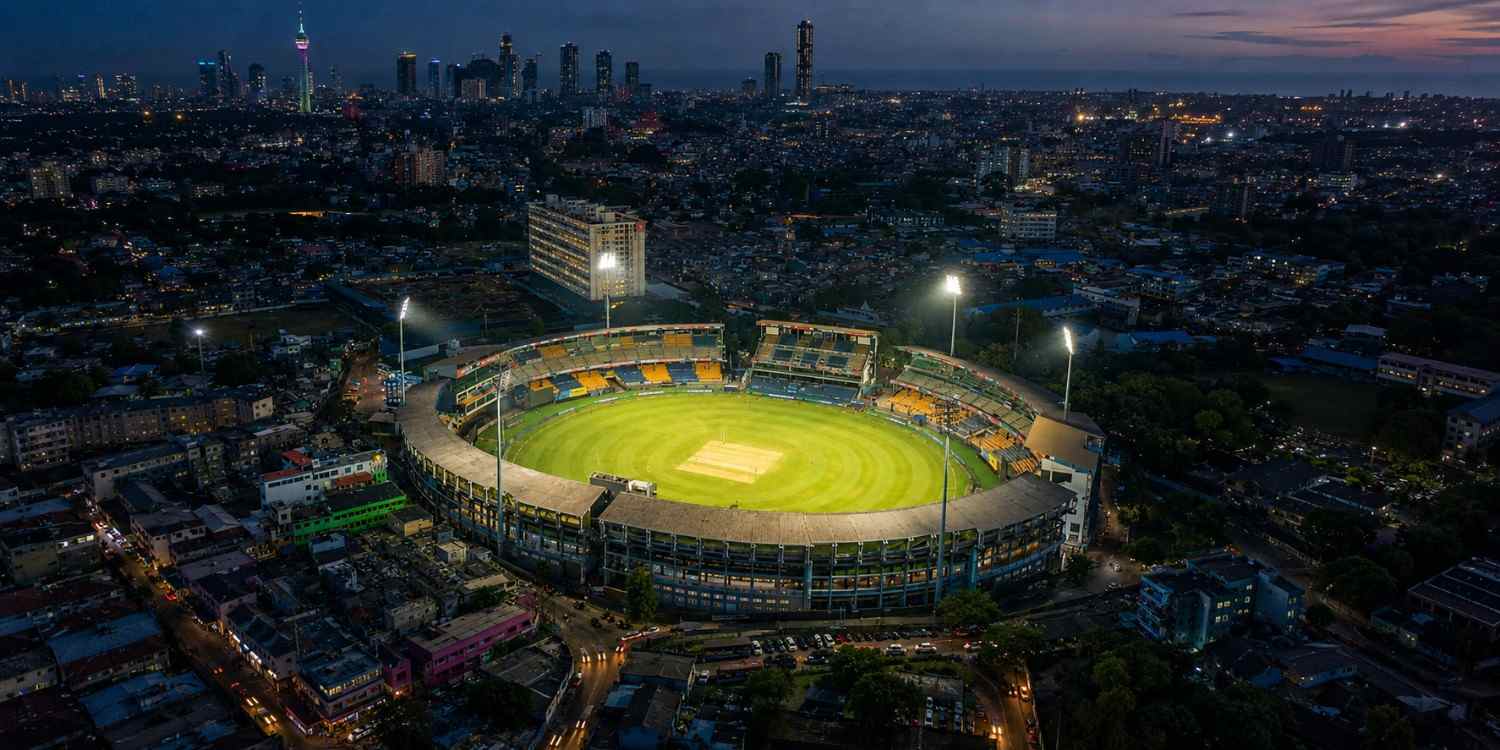
R. Premadasa Stadium is an international cricket ground in Colombo, Sri Lanka. Opened in 1986 as Khettarama Stadium, it now welcomes approximately 35,000 spectators and hosts Test, One Day International and Twenty20 International cricket.
This guide explains how the surface has behaved across formats, which records define the venue, why its tournament history deserves attention and what spectators should check before travelling to a match.
R. Premadasa Stadium Facts at a Glance
| Detail | Information |
| Official name | R. Premadasa International Cricket Stadium |
| Former name | Khettarama Stadium |
| Opened | 1986 |
| R. Premadasa Stadium location | Khettarama Road, Maligawatta, Colombo, Sri Lanka |
| R. Premadasa Stadium capacity | Approximately 35,000 spectators |
| Home team | Sri Lanka |
| International formats | Tests, One Day Internationals and Twenty20 Internationals |
| Floodlights | Available |
| Local time | Sri Lanka Standard Time, UTC+5:30 |
| Commonly listed ends | Khettarama End and Maligawatte End |
| Cricket administration | Sri Lanka Cricket |
From Khettarama to a National Cricket Landmark
The original Khettarama Stadium
The venue opened in 1986 under the name Khettarama Stadium. Former Sri Lankan President Ranasinghe Premadasa championed its development as a major cricket ground in the capital. Authorities renamed it in his memory in June 1994, and it grew into a regular stage for Sri Lanka’s international fixtures.
Renovation and modern development
Major work before the 2011 Cricket World Cup upgraded seating, media areas and match infrastructure. The project prepared the ground for knockout cricket and a larger international audience. Sri Lanka Cricket has also identified the premises as a High-Performance Centre, connecting the historic venue with elite player development.
R. Premadasa Stadium Pitch Report
What the new ball can do
Some fresh strips provide reliable pace and enough carry for confident stroke play. Colombo’s humidity, surface moisture and grass cover can also create brief seam movement. Batters who judge length well can score before the ball softens, although the prepared strip determines the scale of any early advantage.
Why spin influences the middle overs
The ground has a long association with slow bowling. Dry or previously used pitches can lose pace, and the ball may grip as an innings develops. Accurate spinners can restrict boundary options, making footwork and strike rotation valuable. Calling every surface a spinner’s paradise, however, ignores the range of strips used across formats.
How conditions can change later
Wear can make a pitch two-paced, which complicates hitting through the line. Dew during an evening match may produce the opposite effect by reducing a spinner’s grip and helping the ball skid. This venue-level assessment describes historical tendencies. Recent use, grass, weather, format and the selected strip determine actual match conditions.
Is Batting First or Chasing Better?
Long-term men’s One Day International results favour teams defending a target, but men’s Twenty20 International results lean towards successful chases. Neither trend settles the toss decision because the playing surface and evening moisture can alter the balance.
- Fresh pitch: Reliable early pace can support a team that wants to set a total.
- Used pitch: Slower bounce may make later stroke play less secure.
- Heavy dew: A skidding ball can help the chasing side and hinder spin.
- Rain threat: Duckworth-Lewis-Stern calculations can change the value of chasing.
R. Premadasa Stadium Average Scores and Team Records
The table below uses a single men’s international dataset. It excludes women’s internationals, domestic matches and franchise competitions, which explains why figures on other venue pages may differ.
| Format | Matches | Average first innings | Average second innings | Highest team total | Lowest team total |
| Tests | 9 | 327 | 369 | Sri Lanka 952/6 declared against India | Bangladesh 86 against Sri Lanka |
| Men’s One Day Internationals | 158 | 237 | 195 | India 375/5 against Sri Lanka | Sri Lanka 50 against India |
| Men’s Twenty20 Internationals | 56 | 150 | 136 | Bangladesh 215/5 against Sri Lanka | Afghanistan 80 against England |
These R. Premadasa Stadium records require format-specific interpretation. A Test innings can span several sessions, whereas a Twenty20 innings contains 120 legal balls. The R. Premadasa Stadium average score is descriptive, not predictive. Team quality, pitch allocation, match era and weather all affect the historical mean. The Premadasa Stadium ODI records also carry a stronger defending pattern than the Premadasa Stadium T20I records.
Leading Individual Performances
Test records
- Sanath Jayasuriya scored 340 against India in 1997, the ground’s highest Test innings.
- Muttiah Muralitharan leads the venue’s Test bowling list with 36 wickets.
- Rangana Herath took 7/89 in an innings and 12/157 in a match, both outstanding ground benchmarks.
One Day International records
- Kumar Sangakkara made 169 against South Africa in 2013, the highest individual score in the format here.
- Muralitharan collected 75 wickets, the leading men’s One Day International career return at the venue.
- Wanindu Hasaranga’s 7/19 represents the best men’s One Day International innings analysis at the ground.
Twenty20 International records
- Luke Wright’s unbeaten 99 remains the highest individual men’s Twenty20 International score here.
- Hasaranga leads the corresponding wicket list with 24 and owns the best innings figures of 4/9.
Why 952/6 Declared Still Defines the Ground?
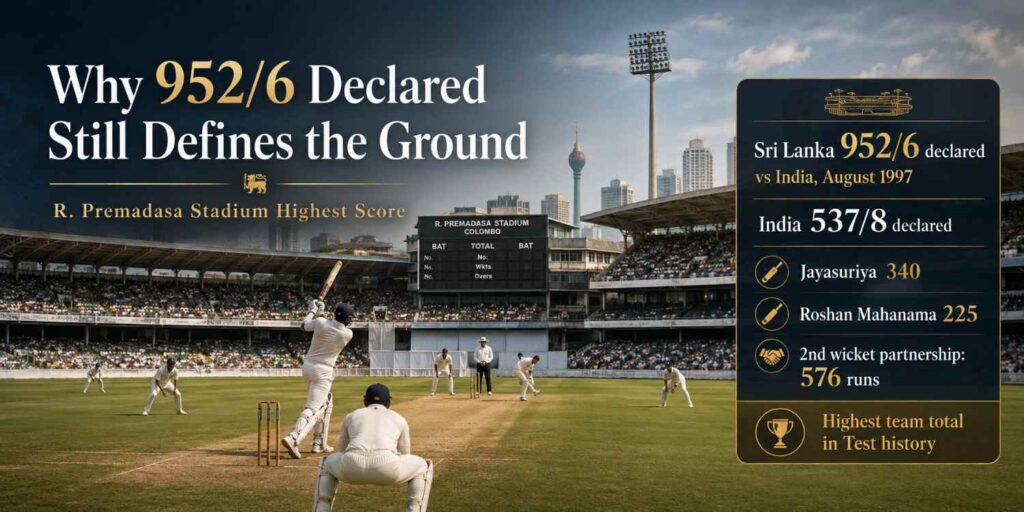
The R. Premadasa Stadium highest score is also the highest team total in Test history. Sri Lanka reached 952/6 declared against India in August 1997 after India had made 537/8 declared.
Jayasuriya struck 340, Roshan Mahanama made 225, and their second-wicket partnership produced 576 runs. The achievement reflects exceptional batting on that particular surface. It does not prove that every modern pitch in Colombo rewards batters in the same manner.
Six Events That Built Its International Reputation
- 1996 Cricket World Cup: Two group matches were assigned to the ground, but Australia and West Indies declined to travel. Sri Lanka received walkovers, so neither scheduled fixture became a completed World Cup match.
- 2002 Champions Trophy: India and Sri Lanka shared the title after rain prevented a result in the final on both the original date and the reserve day.
- 2011 Cricket World Cup: The renovated ground staged knockout cricket, including Sri Lanka’s semi-final victory against New Zealand.
- 2012 World Twenty20: Australia won the women’s final here before West Indies defeated Sri Lanka by 36 runs in the men’s final.
- 2023 Asia Cup: The venue hosted the Super Four phase and final, where India dismissed Sri Lanka for 50 and won the title.
- 2025 and 2026 global events: It served as the only 2025 Women’s Cricket World Cup venue outside India and later hosted completed group and Super Eight matches during the 2026 Men’s Twenty20 World Cup.
Boundary Dimensions and Match-Day Climate
Approximate playing dimensions
Published R. Premadasa Stadium boundary length estimates place many square boundaries between 68 and 72 metres and the straight boundary near 75 metres. Those numbers are guides, since organisers can reposition ropes. For one 2026 international, the International Cricket Council listed square boundaries of 67 and 69 metres and a straight boundary of 79 metres.
Heat, rain and evening dew
R. Premadasa Stadium weather reflects Colombo’s tropical climate, bringing heat, humidity and a genuine risk of interruptions. February is generally drier than several other months, but seasonal history cannot forecast a fixture. Spectators and teams should consult a current forecast. Dew may influence evening matches by making the ball wetter and harder to grip.
Planning a Visit
The ground is on Khettarama Road in Maligawatta. Colombo has several international cricket venues, so confirm the ground name before arranging transport.
- Buy tickets through Sri Lanka Cricket or the competition’s authorised channel.
- Check the gate and stand printed on the ticket before departure.
- Allow extra travel time because match-day traffic can delay road journeys.
- Review current rules for bags, food, cameras and other equipment.
- Consider sun, rain exposure and roof coverage when selecting a seat.
- Recheck transport choices and fares near the match date.
Related post: Maharaja Yadavindra Singh International Cricket Stadium: Pitch, Capacity, Records and IPL Details
Conclusion
R. Premadasa Stadium Colombo brings together Sri Lankan cricket history, format-specific records and conditions that can change with each prepared strip. Its 35,000-capacity setting rewards informed planning. Before any visit or match assessment, check the current pitch, weather, ticket, transport and entry information instead of treating historical averages as forecasts.
FAQs
What is the capacity of R. Premadasa Stadium?
The current International Cricket Council venue profile places capacity at approximately 35,000 spectators. Older sources sometimes cite 40,000, but the lower current figure provides the safer planning reference for readers and event guides.
Is R. Premadasa Stadium a batting or bowling pitch?
Conditions vary by strip and format. Fresh surfaces can support batting, whereas dry or used pitches frequently help spin. Grass, recent use, rain, humidity and evening dew can alter the balance considerably.
What was the Premadasa stadium previously called?
The venue opened as Khettarama Stadium in 1986. It received its present name in June 1994 to honour former Sri Lankan President Ranasinghe Premadasa, who had supported the ground’s original development.
What is the highest Test score at the ground?
Sri Lanka’s 952/6 declared against India in August 1997 is the venue record and the highest team total in Test cricket. Jayasuriya scored 340, and Mahanama contributed 225 during the innings.
Where is the Premadasa stadium located?
The stadium stands on Khettarama Road in Maligawatta, Colombo, Sri Lanka. Visitors should confirm this address because the city also has other prominent cricket grounds, including the Sinhalese Sports Club Ground.
Who owns Premadasa Stadium in Sri Lanka?
R. Premadasa Stadium is owned and managed by Sri Lanka Cricket. The Colombo ground opened in 1986 and was earlier called Khettarama Cricket Stadium.
When was the first cricket match played at R. Premadasa Stadium?
The stadium hosted its first Test match in 1992, with Sri Lanka playing Australia. Its first T20 International came in 2009 against India.
Which stand in the Premadasa stadium offers the best view for international matches?
The Grandstand and Pavilions A and B are generally preferred for their side-on view of the field and more comfortable seating.
Can I buy tickets at the R. Premadasa stadium on match day?
Tickets may be sold at the stadium for some matches. For major international games, booking online in advance through Sri Lanka Cricket is a safer choice.